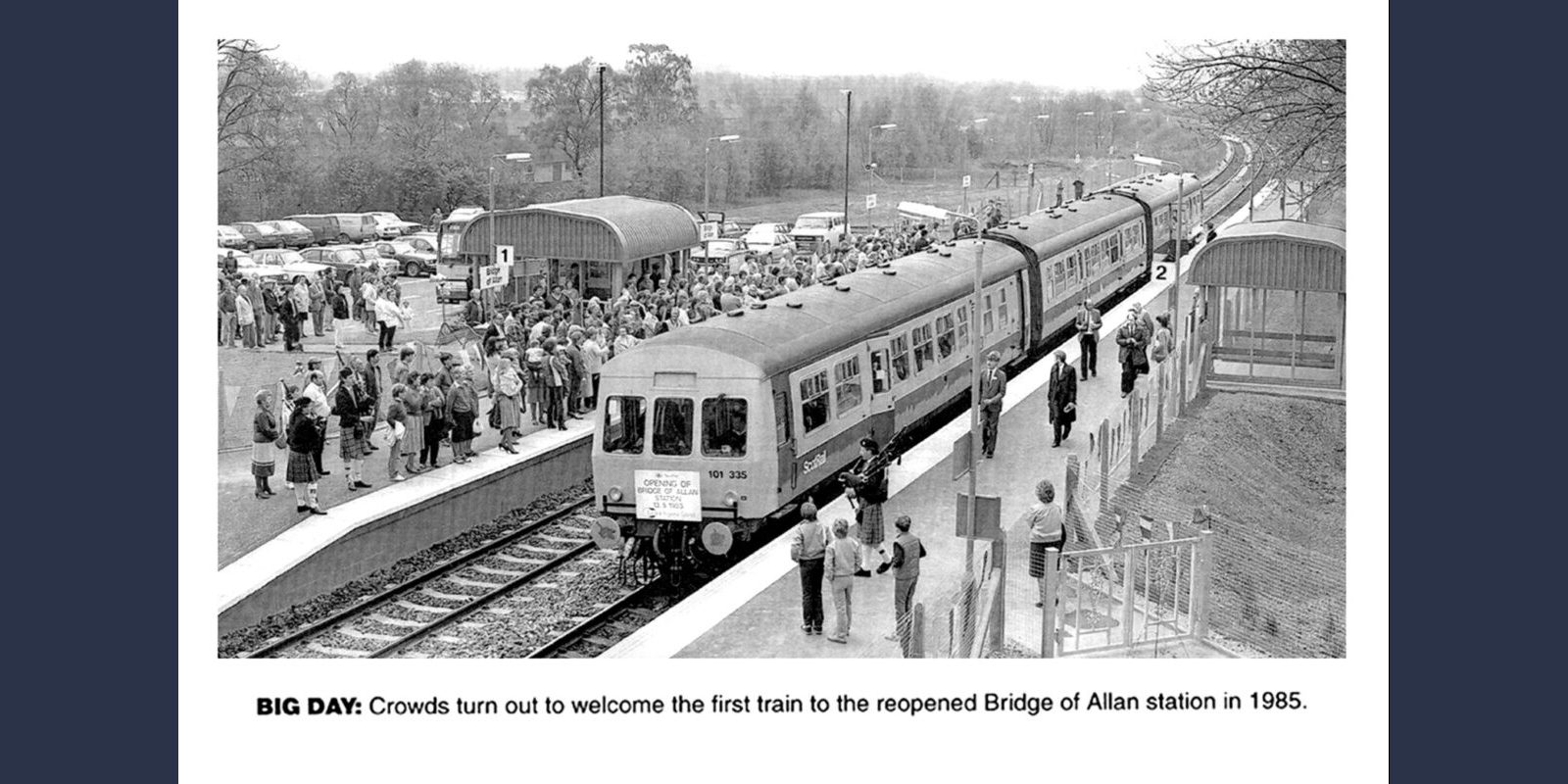
Fortieth Anniversary of the opening of the new Bridge of Allan Railway Station
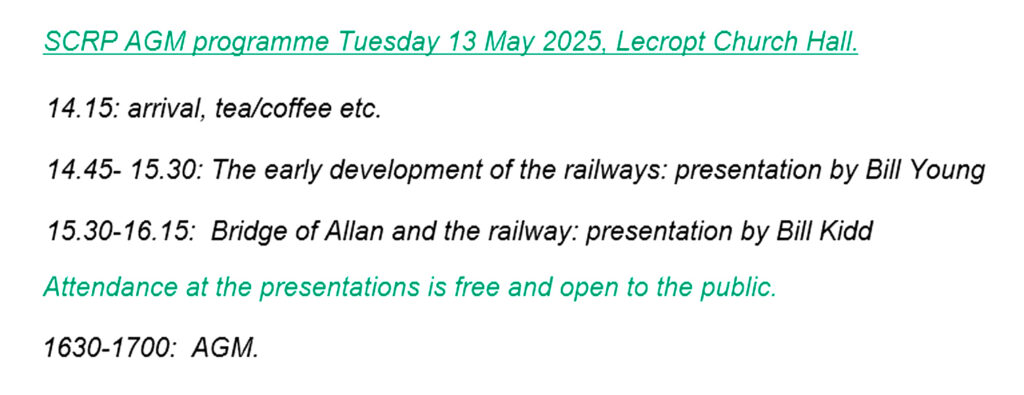
To mark the anniversary on Tuesday 13 May 2025 Strathallan Community Rail Partnership (SCRP) will host presentations on the history of the station as part of its AGM in Lecropt church hall at 1430:
Bridge of Allan’s first station was one of twelve opened in 1848 with the creation of the Scottish Central Railway (SCR) connecting Greenhill junction on the Edinburgh-Glasgow line to Stirling and Perth. Two decades earlier, the beneficial properties of the local mineral waters had triggered the town’s development as a fashionable Spa resort. The new railway connections significantly increased tourist visitor traffic, with a growing demand for hotels, guesthouses, and leisure and recreational facilities. The railway also catered for an emergent middle-class commuting clientele: in 1851 Bridge of Allan published a new residential housing development plan, and in 1857, it was one of the first stations in Scotland to host a John Menzies bookstall. The inauguration in 1858 of the Dunblane, Doune and Callander railway (ultimately extended to Oban) made Bridge of Allan a gateway station for the Trossachs and southern highlands, and the SCR’s absorption in 1865 by the much larger Caledonian Railway network enhanced the town’s direct rail links with other parts of Britain.
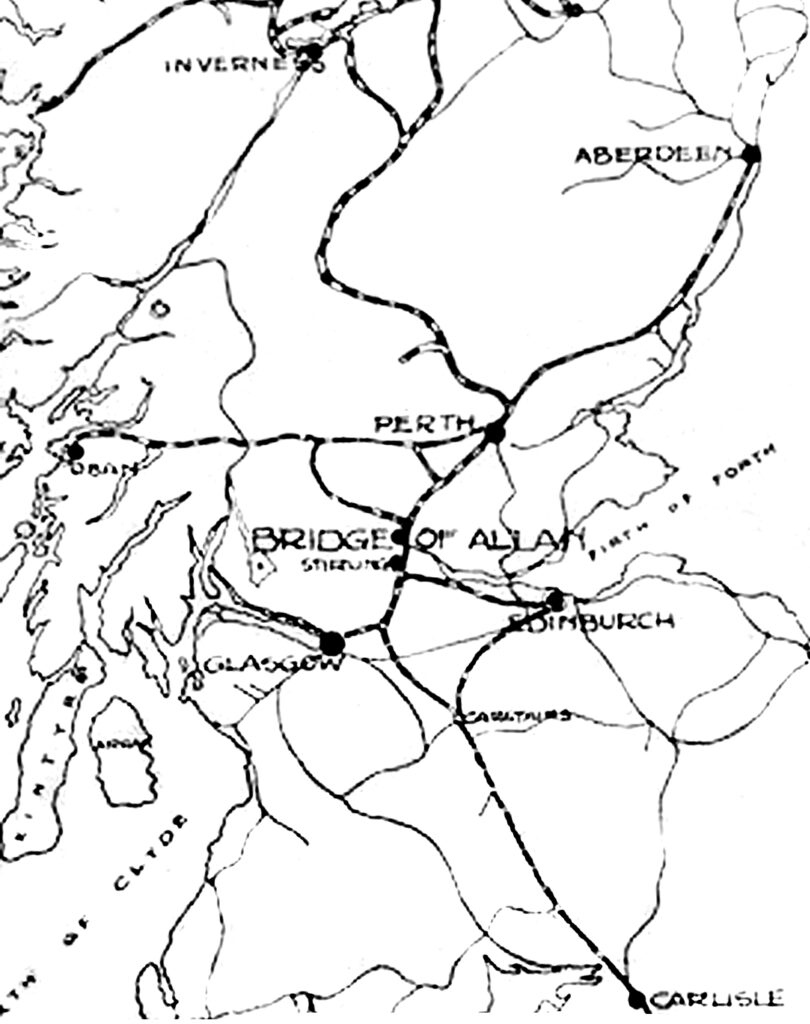
(From A Pictorial Guide to Bridge of Allan, 1906)
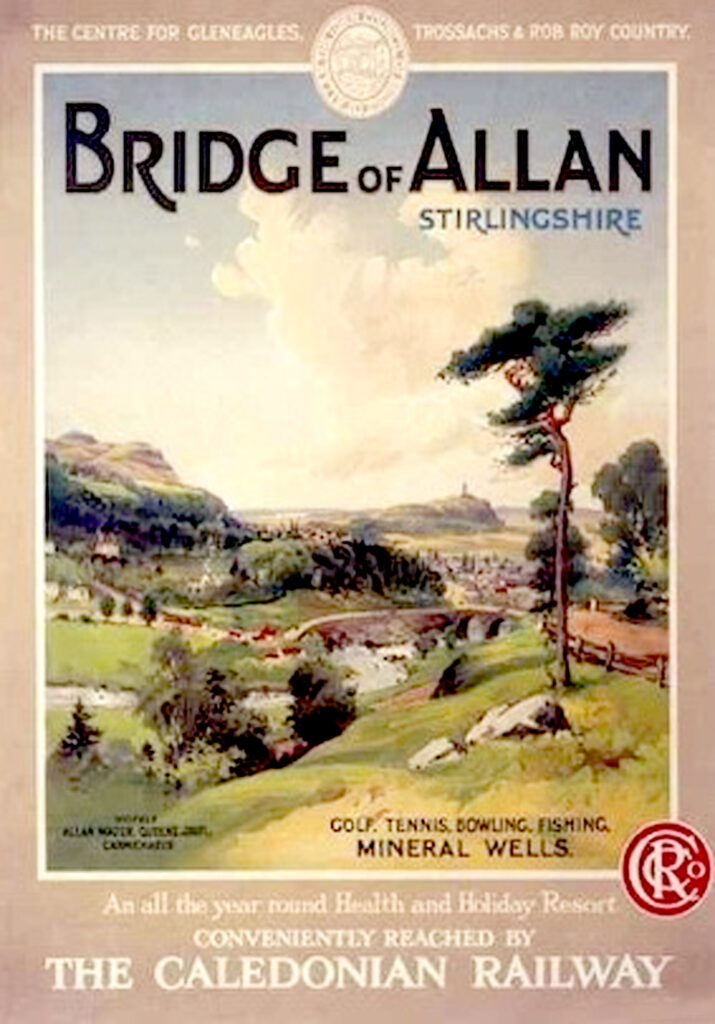
(Vintage Caledonian railway poster, 1914 period)
In its Victorian and Edwardian heyday, broadly the period between 1870 and 1914, annual visitor numbers to Bridge of Allan reached an estimated 30,000, most of whom travelled by train and were met on arrival by hotel charabancs drawn up on the station forecourt, a practice that survived until the early 1920s. During the same period, the station had an impressive staff of fifteen, including the station master, three senior porters, two junior porters, three office clerks, five ticket collectors and a signalman. The adjacent goods yard handled a variety of merchandise, including paper from the local mill; agricultural produce from the carse; seasonal fruit from local orchards picked daily and sent by early morning train to Glasgow fruit market or to Carluke for jam making; imports of raw cotton for processing at Pullar’s Keirfield works, subsequently re-exported; and domestic coal supplies for local merchants Muir and Paton.
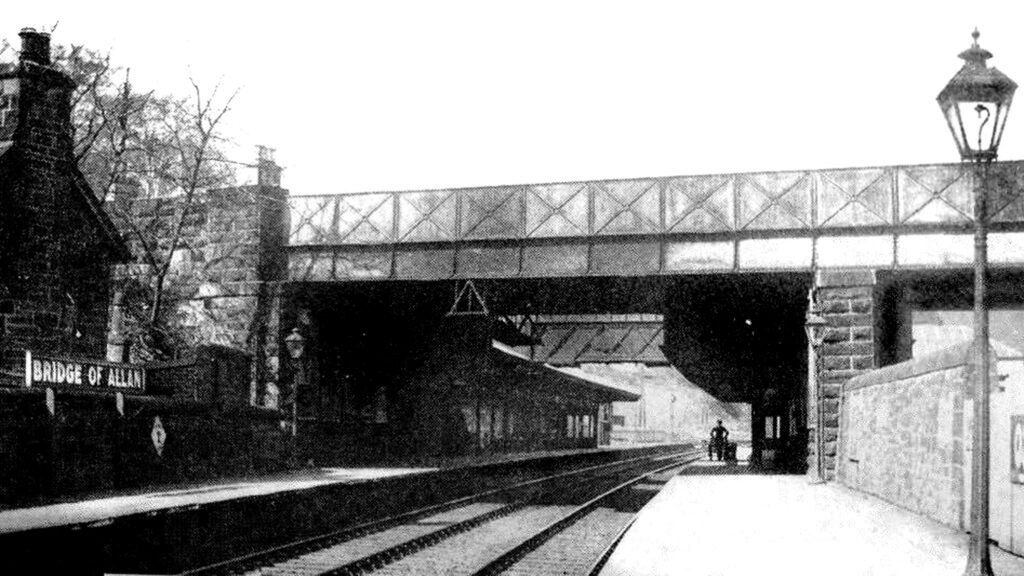
(The original station looking north under the A9 road bridge)
In the inter-war years, the growing availability and reliability of road transport and the increasing popularity of private car ownership impacted on all the major railway companies, leading to the re-grouping of 1923-24 when the Caledonian was incorporated into the London, Midland and Scottish company. Against the backdrop of a long period of gradual decline, interrupted by the second world war and railway nationalisation in 1948, some
routes were no longer considered economically viable and in 1964, following the Beeching Report recommendations for a radical programme of closures, Bridge of Allan station was among those earmarked by the Ministry of Transport. Despite arguments advanced by the Transport Users’ Consultative Committee, including the projected establishment of Stirling University on the Airthrey estate, and objections from both Bridge of Allan and Stirling Town Councils, the station was closed at the end of October 1965 and subsequently demolished.
Thanks to the far-sightedness of some local citizens, one of the station’s iconic blue and white name boards and other artefacts were saved for posterity and now form part of the Dr W H Welsh Trust’s heritage collection.

During the two following decades, the consolidation of the University’s staff and student population created new sources of demand for better transport facilities. Concurrently, railway modernisation and innovation, together with a recognition of the amenity of park and ride schemes, and growing awareness of the social and environmental benefits of rail produced a compelling case for restoring the town’s railway connection and on 13 May 1985 a new station, built south of the original location with on-site car parking and, unlike its predecessor, unmanned, was formally opened in the presence of enthusiastic onlookers.
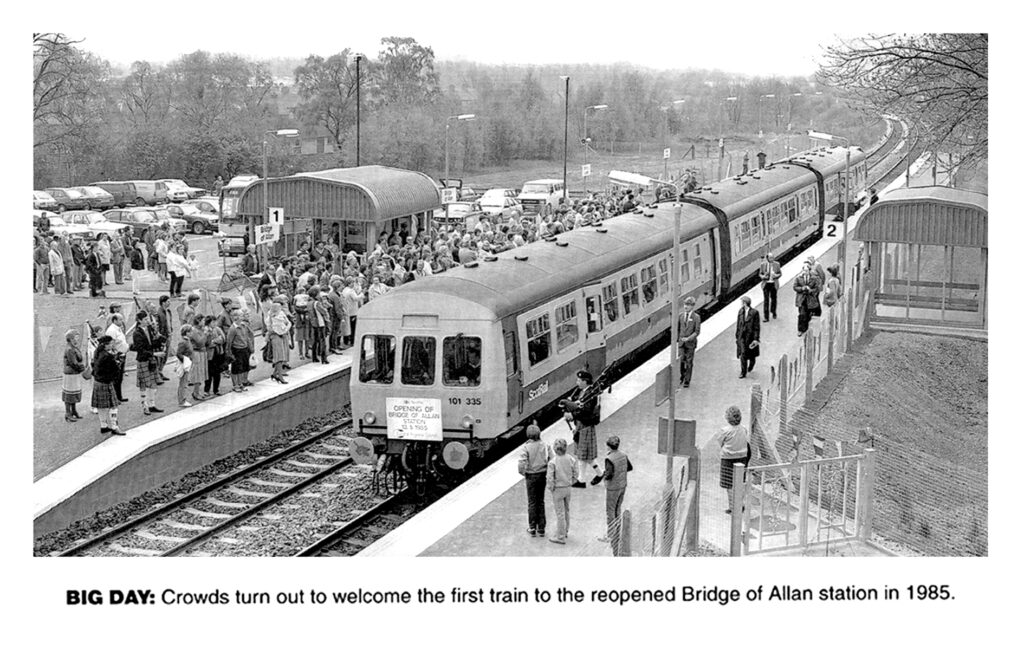
Rail passenger journey numbers from Bridge of Allan subsequently increased year on year and electrification of the main Edinburgh and Glasgow routes has improved service speed and reliability. The station today is once again an essential part of the town’s transport infrastructure.
Prepared by Bill Kidd. Illustrations from the Welsh Trust collection.