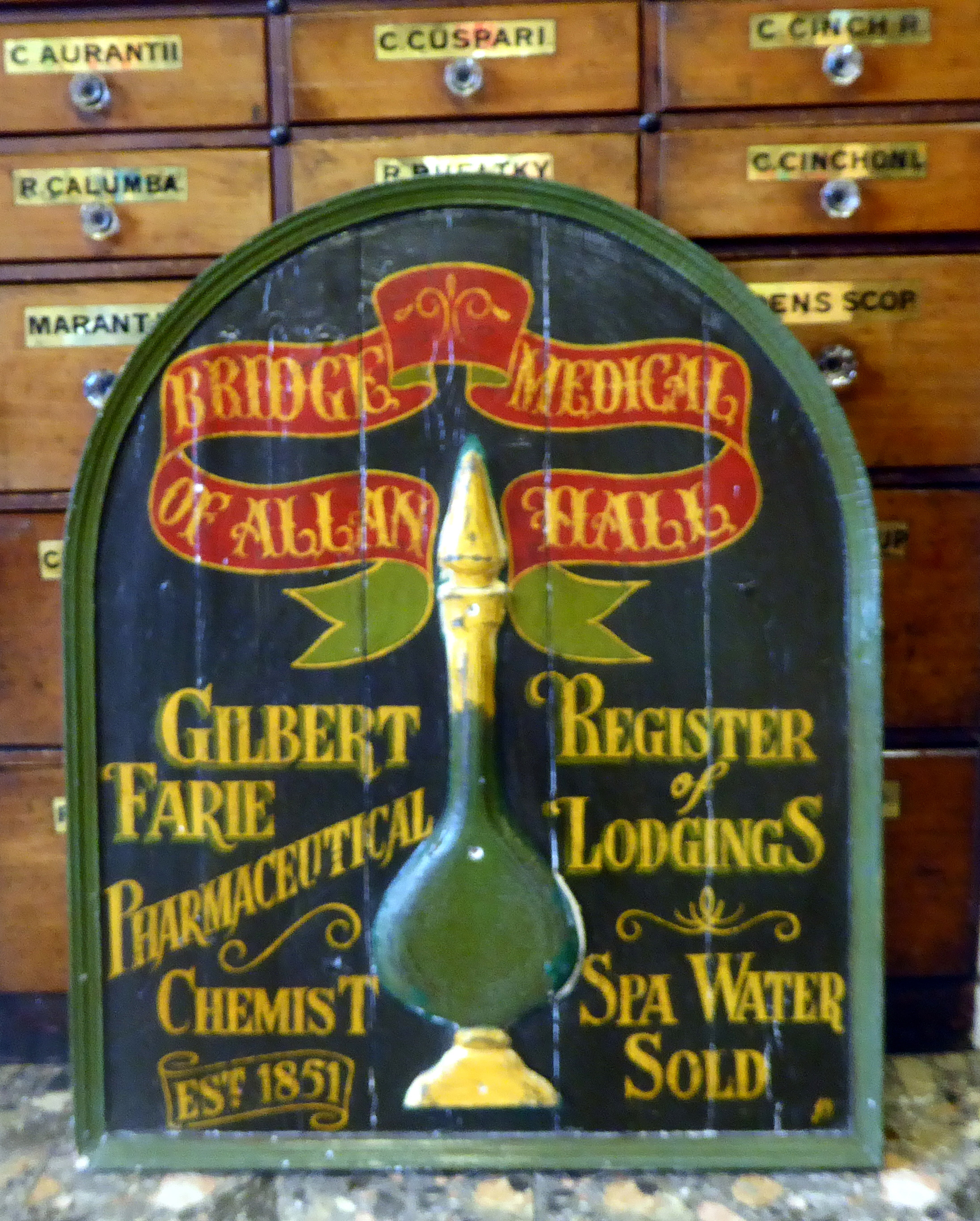
Gilbert Farie
The following account of Gilbert Farie, was researched, compiled and written by Ken Gray.
If today you were to pick up a telephone directory for Glasgow City or the West of Scotland and looked up the surname FARIE you would find no entries at all. And yet throughout the 17th and 18th centuries there are frequent references in Burgess Records to
• William Farie, tailor 1650
• Gabriel Farie, maltman 1655
• James Farie, hammerman 1655
• Gabriel Farie, son of the last mentioned, weaver 1704
• George Farie, weaver 1748
• Robert Farie, hammerman 1750
• David Farie, weaver 1750
But I wish to concentrate on a Robert Farie, who appears in John Tait’s Directory from 15th May 1783 to 15th May 1784 listed as
“Robert Farie, bookseller, Saltmarket”. In Jones Directory for 1789 he is again listed as “Robert Farie, bookseller, Saltmarket, shop no 16”.
And in the Post Office Directory for 1801 he appears as, “Robert Farie, bookbinder, Saltmarket”.
The Glasgow of Robert Farie was one of transition, much yet remained of the old, but the first manifestations brought about by industry were to be seen. Glasgow’s first period of marked growth was in the 18th century, and was brought about by trade with the American colonies, largely in tobacco and sugar. Glasgow Cross was the centre of the City when the Tobacco Lords strutted about in their finery outside the Tontine. The shop of Robert Farie was close to the heart of this world. In 1700 the population had been 12,000; in 1800 it had become 77,000. The City was on the move. The Exchange was soon to move from Trongate to Queen Street. The bookbinding business of Robert Farie also relocated in 1819 to 54 Trongate and remained there at Post Office Court for 10 years. It moved then to 57 Argyll Street, whilst his own residence was at 57 Oswald Street. In 1838 the firm became Robert Farie & Co, and we find a James Farie, presumably a son, working in the business. In 1842 the firm is listed as Farie & Nelson, Bookbinders with the Nelson partner being a Thomas Nelson. I have not had the opportunity to investigate this link further but the date would hint that this might well be Thomas Nelson Jnr, son of the founder of the publishing house which was founded in 1789 by his father, Thomas Nelson, a native of Throsk. The bookbinding business ceased in 1848.
Gilbert Farie was born in 1832 whilst the family resided at 57 Oswald Street. Close family relatives, Robert Farie, merchant, 23 Monteith Row and Gilbert Shearer Farie, merchant, 30 Monteith Row, a Cotton Yarn Manufacturer of the firm Johnston & Farie, cotton yarn merchants, 62 Wilson Street, showed by their fashionable street address that they belonged to the wealthy merchant class of Georgian Glasgow. Other family members the Farie’s of Farme had considerable coal interests in Lanarkshire. Some of these family members appear as visitors to the Spa in the Bridge of Allan Reporter in later years.
According to his obituary in the Bridge of Allan Gazette Gilbert Farie had studied at the University of Glasgow and had assisted a Dr Penny at the Andersonian Institute, now Strathclyde University. He was appointed apothecary at Glasgow Royal Infirmary. However in 1851 he came to Bridge of Allan as assistant to Charles Neil Rutherfoord , at that time the only Chemist and Druggist in the village and indeed the Census return for 1851 shows that Gilbert was living in the same house as Charles Rutherfoord .
The year was 1851. What was happening in the nation at that time? A distinguished historian on the Age of Queen Victoria wrote, “Of all the decades in our history, a wise man would choose the eighteen-fifties to be young in”. There was a general optimism after the economic difficulties of the 1840s; the cost of living had come down and improvements had been introduced in the area of social justice. The drift from countryside to town continued to accelerate and half the population of twenty million were now urban dwellers. For the youthful in 1851 the prospects were certainly encouraging and there is significance in the very prevalence of the expression, “to rise in life”. For the commercially minded the age was an ideal one, and for technicians, all sorts of new careers were opening up as scientific advances were made.
In the world of Pharmacy, 1841 had seen the establishment by Royal Charter of the Pharmaceutical Society of Great Britain. Only nine out of approximately 700 members were resident in Scotland. There were many more working in Scotland as Druggist Apothecaries, or Chemists and Druggists. Many of these wished to become Members of the Society but in order to sit the examinations it was necessary to travel to London. The Pharmaceutical Journal in 1851 included an Editorial , part of which read, “We are informed that there are many other Chemists in Scotland desirous of becoming Members, but precluded from doing so because it is not convenient to them to come to London to pass the examination” That year a Board of Examiners was appointed in Edinburgh. Gilbert Farie registered as a Member of the Pharmaceutical Society of Great Britain on June 1 1853.
He had by that time established his own pharmaceutical business in Bridge of Allan which he called Bridge of Allan Medical Hall. His obituary in the local newspaper tells us that it was in premises, “presently occupied by Keith & Ralston.” There were many visitors coming to the Spa and Charles Roger’s publication “A Week at Bridge of Allan” was acting as a guide to the locality for them. Perhaps however because of his background with a father who was a printer and bookbinder he commenced publication of his own guide to the village entitled Farie’s Guide to Bridge of Allan.
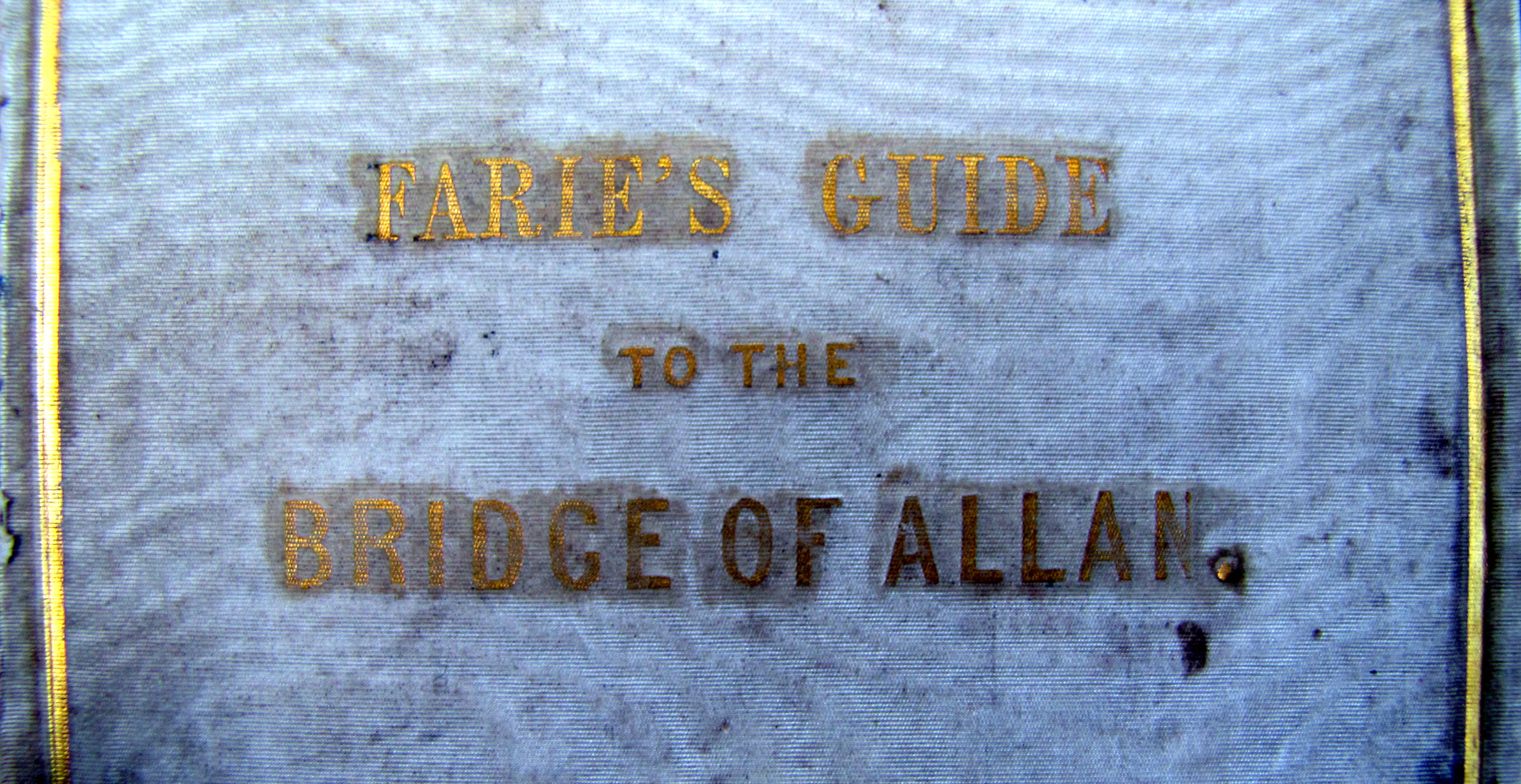
It was reviewed in the Stirling Journal and Advertiser in the following terms:
“We owe an apology to the compiler of this little work for not having noticed it sooner. The fact of the matter is that we have an instinctive horror of guide-books and could not be brought for a day or two to open this one on any account. Having resolved , however, after a severe course of mental discipline to see what was in Farie’s “Guide” we sought for it among the many pamphlets and papers with which our table is always crowded, and lo! it was nowhere to be found. After a lapse of several months, during which nothing could be seen of the book, it turned up again the other day, gazing out from among a heap of all sorts of literary rubbish, like a mute accusing angel. To examine its contents, and to come to the conclusion that it was, both in point of exactness of information and of literary ability, one of the best books of its kind, was the work of a short half-hour. There was, it is true, to be discerned here and there a slip, consisting of at one time a verbal inaccuracy, and at another a slight mistake as to the distance between two places, but upon the whole, we have no hesitation in saying that it is in the main sufficiently trustworthy to make it indispensably necessary to every one who sojourns for a time, either long or short, at the Bridge of Allan.”
By 1858 it was in its fourth edition. It is interesting that one of the advertisements in that edition was for a bookbinder, Colin Frame, who respectfully intimated that he had removed from Royal Exchange Court, 85 Queen Street, Glasgow to 90 Mitchell Street, first entrance below Gordon Street. Gilbert Farie’s mother’s maiden surname was Frame and on August 6th 1858, a Mr Colin Frame and Mr Robert Frame were listed in the Bridge of Allan Reporter as visiting Bridge of Allan. Since in later life Gilbert’s first son was named Robert Frame Farie, I would guess that these gentlemen were Gilbert’s uncle and grandfather.
In 1851 Bridge of Allan held the first Strathallan Meeting in the grounds of Westerton House so in 2001 the Bridge of Allan Highland Games also celebrated its 150th anniversary. In the 1852 meeting there were 23 events and the last event, the Pony Race was won by Gilbert Farie. By 1858 he had become the Secretary of the Strathallan Gathering.
When one reads the local newspaper, The Bridge of Allan Reporter, for this period, one begins to form an image of this man who appeared to become closely involved with all aspects of the life of the village. He was quite obviously not a modest man as the advertisement for his own business in his own Guide Book implies. In 1856 he wrote:
“In returning his sincere thanks to the inhabitants of Bridge of Allan, Dunblane, and Blairlogie, and to the numerous strangers visiting and residing thereat, for the liberal support which they have bestowed upon him since commencing business nearly six years ago, begs to intimate that his present arrangements will enable him to comply with the wishes of his numerous friends and customers, and meet the demands of a daily increasing business.
Aware that his flattering success has been owing mainly to unremitting personal attention to business, scrupulous care in dispensing, and above all, the genuine character of every article supplied by him, he can assure his friends that such will for the future be secured, if possible, in a yet greater degree.”
In addition to his pharmaceutical interests and his promotion of the Spa through his Guide Book he kept a Register of Lodgings and acted as a House Agent. “Parties intending to visit the Spa may ascertain the accommodation which can be obtained by enclosing a stamped addressed envelope to G. Farie, Medical Hall in which a copy of the register will be transmitted.” Throughout his life in Bridge of Allan he acted as the equivalent of today’s estate agent. In 1882 he advertised in the Stirling Journal & Advertiser that as a licensed house agent he had a number of houses to let and listed them in the advert. He did the same in the following year, but in earlier years had stated “House to let, Furnished in whole or part for Winter months or permanent lodgers desired. Moderate. G Farie”
He also acted as agent for the Stirling Journal & Advertiser for advertising in its newspaper – “to reach the wealthy classes who frequent this fashionable watering place”
But he was also acting as an employment agent too since newspaper advertisements seek to fill the following vacancies: “Wet Nurse wanted. Healthy young woman from the country preferred – Apply to G Farie”
“Wanted a good daily governess – Apply to Mr Gilbert Farie, Pharmacist, Bridge of Allan”
To say that this young man had his fingers in many pies is putting it mildly. In 1858 he was the Secretary and Treasurer of the Bridge of Allan Concert and Music Hall, which occupied the site on the corner of Fountain Road and Henderson Street where the supermarket currently sits. When in 1860 an exhibition of wax figures, including the Royal Family – life size – came to the Music Hall. Cards of Admission were available from Mr G Farie. For most Spa residents and visitors this would be perhaps the only opportunity to see an approximation at a likeness of their Sovereign.
Orders were taken at his pharmacy for the hiring, tuning and repairing of harmoniums – also mouth harmoniums were offered for sale.
In 1866 he was advertising Farie’s Extra Carbonated Lemonade from the Strathallan Aerated Water Manufactory and the Strathallan Scotch Pebble, Clan Tartan and Fancy Goods Emporium. There is no doubt that he sought to benefit at every turn from the visitors who were at that time flocking to the Spa.
His business was prospering and in 1857 a decision was made to re-locate to new purpose built premises. What should be more natural than that a son of Glasgow should have the plans drawn up by a Glasgow architect who had opened his own practice in 1844. The name, John Burnet, 113 West Regent Street, Glasgow appears on the plans with the date 1857. And so the current premises occupied by Strathallan Pharmacy opened on 7th May 1858, the work of the same architect responsible for Merchants’ House, George Square; the Clydesdale Bank, St Vincent Street; and the Glasgow Stock Exchange.
From these “new and commodious” premises in Bridge of Allan a bewildering array of patent and proprietary medicines, appliances and convalescent supplies were offered, including Finest Swedish Leeches received fresh every week. In 1858 a young Robert Louis Stevenson visited Bridge of Allan with his family. During the Stevenson’s visit of May 1858, the seven year old Lou fell ill at the Queen’s Hotel. The local medical practitioner Dr Alexander Paterson was summoned and diagnosed bronchitis. Two days later the sick little boy was transferred with his family to Miss Robertson’s Lodgings (Kenilworth House) where he began to recover. In his book “R.L. Stevenson and the Bridge of Allan” Canon J A McCulloch, Rector of St Saviour’s Church wrote,
“The boy Stevenson must often have dawdled along Henderson Street with Cummy, and descended the “UP Brae”, and ran down the zig-zag path from the lodging-houses on the hill to get his medicine made up, and to make polite conversation with Mr Farie, the druggist”
Indeed in 1880 writing from San Francisco in “Memoirs of Himself” Stevenson described the effect that Farie had on him as a little boy, and the characteristic way that he dealt with this:
“Fairy (sic) the hunchback druggist of Bridge of Allan, was a terror to me by day and haunted my dreams at night; but my pity was stronger than my distaste; and I made it a point to command myself and speak to him with a child’s friendliness whenever the poor, vain man, little understanding what was in my heart, condescended to address me.”
Dr Paterson and Gilbert Farie were both professional colleagues and friends, and one day whilst out walking together in the vicinity of the Airthrey Paper Mill were called to attend to a female mill worker whose dress became caught up in a machine. She was dragged into the machinery and the doctor and pharmacist performed an amputation. The patient survived for a few days but then died. On another occasion they performed a similar operation in the Waiting Room of Bridge of Allan Railway Station on Peter Jaffray, the local plumber. He had fallen from the platform when the train moved off and had his arm severed under a carriage wheel.
The New Medical Hall was open from 7am until 9pm during the week, and on Sundays from 10-11am and from 6-8pm. When the establishment was closed medicines required in the case of emergency could still be obtained at all times by ringing the Night Bell at the West End of the House. The night extra charge from 9pm to midnight was sixpence, and from 12pm to 7am one shilling. Since Gilbert did not reside on the premises I should imagine that an apprentice was responsible for night duty. Indeed Strathallan House which occupied the rest of the premises not part of the Medical Hall had a landlady and took in lodgers whose names appear in the Visitor Lists published in the local newspaper.
On 2nd August Mrs Forsyth’s lodgings at Strathallan House were visited by Mrs Robert Farie; the Misses Farie; and Mr Robert Farie. And they remained throughout the entire months of August and September leaving in the week after the 27th September. There were frequent visits of his Glasgow family members who in 1865 stayed for Christmas at Strathallan House.
Throughout all this period Gilbert Farie had remained a bachelor. And indeed it was not until 1878 that he married Anne Haywood, the daughter of a wealthy Nottingham industrialist. Quite how they met will forever remain a mystery. What is known is that her father John Shrewsbury Haywood, a hosier, of Nottingham first conceived the idea of the first elastic stocking. In a city which was renowned for its hosiery business he produced a stocking which would not only lend support to a limb, but would also, at the same time, give and stretch. This is the basis of the method still in use today. His son, Anne’s brother, John Harrington Haywood joined his father in the business and his remarkable discovery was the seamless stocking of which he was the sole inventor and patentee.
The Haywoods lived in Alexandra Park on the outskirts of the city of Nottingham in a small enclave of fashionable houses. One of their neighbours was John Player, the tobacco magnate.
I have visited both Shrewsbury House, the family home and St Andrew’s Church in which they were married on the 14th November 1878 and have seen the marriage register which interestingly contains the unsteady signature of an elderly Robert Farie, father of the groom. The newspaper account of the proceedings gives a fascinating insight into a Victorian wedding.
John Harrington Haywood who had acted as groomsman at the wedding went on to succeed his father in their business in Castle Gate, Nottingham. At one time a certain D H Lawrence aged 13 was employed manually at a wage of 13/- a week. He did not stay long, but left to become a pupil teacher. As a novelist Lawrence used a Nottinghamshire background in his “Sons and Lovers” , a story that is to some extent autobiographical. Lawrence makes his character Paul Morel, at the age of 14 years, apply for a job with a firm called “Thomas Jordan and Son – Surgical Appliances” whose place of business was off a narrow street that led to the Castle, where, through a dark archway, he found “ a big warehouse, with creamy paper parcels everywhere” in which he was to work as a clerk. Some of Haywood’s older employees were able to recall the likeness between the author’s characters and the people who worked at Haywoods.
I have searched the Visitor Lists for Bridge of Allan and Dunblane for visits by the Haywoods prior to 1878 and have not found any. As I said earlier the circumstances of their introduction remains a mystery.
On the 26th August 1879 their first daughter, christened Annie Harrington Haywood Farie was born; followed by a son Gilbert John Farie on 26th May 1881. On 29th May 1883 a second daughter Jane Haywood Farie was born and she was followed by the last child to be born to the family, Robert Frame Farie, born on 26th December 1884.
If this were a real fairy story the scene now would seem to be ideal, a perfect Victorian family living in respectable comfort in Bridge of Allan. But visitor numbers attending the Spa were dropping and indeed in June 1884 Gilbert Farie was placed on a Committee to consider a new Guide Book to Bridge of Allan, in order to reverse the trend. He was still advertising Houses to Let. By March 1886 the situation had become so serious for him that he appeared at the Edinburgh Bankruptcy Court and was declared bankrupt. On the 17th April 1886 he advertised in the Bridge of Allan Reporter a change of name for his business to Gilbert Farie & Co. However the toll of these matters must has been considerable upon his health because on 2nd October of that year he died , the cause of death given as meningitis.
A considerable obituary was published in the Bridge of Allan Gazette.
The Late Mr Gilbert Farie
Mr Gilbert Farie, chemist and druggist, died at his residence Strathallan Villa, last Saturday evening at the age of 54. His remains, in accordance with his own previously expressed desire, were interred in Lecropt burying ground on Wednesday. No funeral intimations were issued, yet notwithstanding a most representative company, including several from a distance, paid their last tribute of respect to the deceased.
All the shops on the line of the route to the churchyard were closed. The deceased was very widely known and respected. Having studied at the University of Glasgow and assisted the late Dr Penny in the Andersonian Institute, he was appointed apothecary to the Glasgow Royal Infirmary, in which institution he obtained an insight (which he was not slow to take advantage of) into the treatment of various forms of ailments, which proved of great service to himself and benefit to others in later years.
He came to the Bridge some 35 years ago as assistant to Mr Charles Neil Rutherfoord, at that time the only apothecary in the village, and whose shop occupied the same site as that presently occupied by Mr Oswald Robertson, chemist. He commenced business on his own account in the shop presently occupied b Keith and Ralston, ultimately building the property in which the handsome shop is situated which he occupied at the time of his death.
As a public man, his services previous to the adoption of the Police Act were invaluable to the village, of which it may be said he was a native. He did his share of work as a member of the Commission, held the Offices of Master of St John’s Lodge, and trustee of the Established Kirk of which he was a member. He published a book entitled “Farie’s Guide to Bridge of Allan”. Many can never fail to remember the timeous kindnesses rendered by the deceased. He was ever ready, in season and out of season, to succour and to aid in various ways the distressed.
Many in the absence of medical assistance has he been the means of relieving, and during the long and weary hours of night often was he the attendant on the suffering and the dying. His midnight vigils, soothing and solacing the afflicted, tended in no small degree, we fear, to break down at a premature age a constitution never robust. He will be missed. He leaves a widow and four young children to mourn his loss, and for whom much sympathy is expressed. Rev John Reid officiated at the house, while the solemn and impressive service conducted by Rev P W Young at the grave was much appreciated by the mourners. We understand that Mrs Farie, with the aid of a confidential and thoroughly qualified assistant, will continue to carry on the business.
This left his widow with children of 7yrs, 5yrs, 3yrs, and not quite 2yrs of age. She now found herself with a pharmacy business and declining business interests, and a young family to raise. The pharmacist who reported Gilbert’s death to the Registrar continued to work for many years in the family’s employment, and Mr George Laing must have been a terrific support to them. The youngest child Robert within 3 years joined his father in Lecropt Churchyard, his death due to laryngitis.
Whereas in Gilbert’s day his activities in the community were well documented in the local press after his death the family lead a private life and only rarely was any mention made of them.
In 1902 whilst his son Gilbert Farie was a medical student at Edinburgh University he distinguished himself by become medallist in two areas of study, Diseases of the Eye and Diseases of Tropical Climates. Prior to the outbreak of the First World War he was in practice in Wimbledon but then was appointed to a Temporary Commission as Lieutenant, Army Medical Corps on 1st October 1916. He was promoted Captain a year later and in March 1919 relinquished his commission, whilst retaining the rank of Captain. He was awarded the Military Cross in the Birthday Honours, June 1919.
During the Great War his eldest sister Annie Farie was on the staff of the Hyndwood Auxiliary Hospital, Bridge of Allan which cared for wounded soldiers. She also organised Flag days on behalf of a number of charities assisting in the war effort and the not inconsiderable sums raised are detailed in John J McKay’s book “Bridge of Allan’s Activities in the Great War”.
Her younger sister however had gone into the family business and although she never had a formal pharmaceutical education many believed that she was a qualified chemist. She worked alongside a number of pharmacist managers and support staff. There are still a number of Bridge of Allan male residents who were employed as message boys by Farie & Co. Earlier in the century however and prior to the Great War it was obviously the custom of errand boys to inscribe their name in pencil on the hidden sides and backs of wooden drawers in the dispensary. The names George Abercromby, William Watson, James McAlpine, Robert McKenzie, Charles McKay, are all scrawled on the wooden drawers, together with the name Laurence Allan, Allanbank and the date 1/12/1913. You can find that same name inscribed elsewhere in Bridge of Allan on the Memorial to the Fallen of the Great War in the Pullar Park.
Jeanie Farie has her name inscribed in Bridge of Allan’s history in her success in a golf competition in Bridge of Allan in 1908. I have the silver trinket box which she won here tonight. She continued to play her part in village life through the Second World War and then in 1947 she employed a new pharmacist who in the 1950’s went into partnership with her and her sister, Annie. That gentleman was my father and the Farie story nears its conclusion.
As successor to my father in Strathallan Pharmacy I often muse and wonder what the father of the business, Gilbert Farie would think if he could return today to view the enterprise which he started. Electric light and heating, the telephone, the computer, a vast array of potent pharmaceutical products, motor vehicles.
In this life we own nothing, however wealthy we may consider ourselves to be, we are only tenants of what we currently possess. In consequence my family have been tenants of Strathallan Pharmacy, we have inherited the Farie story and if I were granted one wish it would be that it lives happily ever after.